TV Review: South Park, "You're Getting Old, Part 1"
Stan turns 10.
There's a lot of talk now about what the fate of South Park will be. It's been an unorthodox show, and it's no stretch to suggest it will have an unorthodox ending. "You're Getting Old" wasn't a particularly good episode in a string of not particularly good episodes with occasional spikes of genius, and if listening to the DVD commentary on many of their episodes is any indication, it's clear that Trey Parker and Matt Stone know a bad episode when they've made one; it's unlikely the decline in quality has gone unnoticed. Some might call that perspective "cynical." But this doesn't feel like a response to critics - Stan is a poor choice for an avatar of the audience when he's so clearly the common avatar of Trey Parker - and could well be a response to their own reactions, as they, like most, have probably come down with an occasional case of being a cynical asshole themselves. And if this is a damning response to a judgmental audience, then what are we to make of the final conversation between Sharon and Randy?
It's been fifteen years and Parker and Stone have now broken forty. While I don't believe that getting old means talent is necessarily lost I do believe it's necessarily changed. No one has the same outlook they had fifteen years ago, and maybe what seemed like a stupid waste of time then appears more worthwhile now, and vice versa. Their most successful contemporaries are now habitually producing season after season of trash, and there may be concern over becoming another Simpsons or Family Guy: achieving great things, and then going into a steady decline that leaves a sour taste in the mouths of fans that lasts for years and even decades. When I watch any modern episode of either of those shows, I wish that someone had had the force of will and foresight to pull the plug long ago. Trey and Matt can't want the same thing for South Park.
Maybe it's premature to be saying things like this, but my hope is that this is the final season, and "You're Getting Old" actually makes me more excited for what could be the series' final episodes.
Showing posts with label TV Review. Show all posts
Showing posts with label TV Review. Show all posts
June 12, 2011

April 16, 2011
The Superego Problem
TV Review: Fringe, "Lysergic Acid Diethylamide"
 With Bell's consciousness at risk of destroying Olivia's, Walter and Peter become more frantic in their efforts to separate them. Walter and Bell devise a scheme to enter Olivia's mind and attempt to free her. Guest stars the voice of Leonard Nimoy, directed by Joe Chappelle.
This episode promised to be another focus of Bell-possesses-Olivia again, which I was already getting tired of. Then when the dream sequence began, it felt like a very derivative and tacky imitation of Inception and I was getting used to the idea of hating it, despite liberal use of LSD, which I wish I would see more of on TV. From there, however, it quickly became a very stylistic and unique milestone for the series, and it made me glad that this is a show I watch. The animation was pretty awesome, reminded me a lot of Waltz With Bashir, and was put to good effect for what had otherwise been a rather banal interpretation of Olivia's subconscious. And not only did the episode serve as a fond farewell (though I hope it's the last) to William Bell, but also possibly introduced what the show has lately been lacking: a new villain. The episode also benefited from the extra attention paid to Broyles, who generally goes unnoticed. But poor Astrid never got to do any acid.
This episode promised to be another focus of Bell-possesses-Olivia again, which I was already getting tired of. Then when the dream sequence began, it felt like a very derivative and tacky imitation of Inception and I was getting used to the idea of hating it, despite liberal use of LSD, which I wish I would see more of on TV. From there, however, it quickly became a very stylistic and unique milestone for the series, and it made me glad that this is a show I watch. The animation was pretty awesome, reminded me a lot of Waltz With Bashir, and was put to good effect for what had otherwise been a rather banal interpretation of Olivia's subconscious. And not only did the episode serve as a fond farewell (though I hope it's the last) to William Bell, but also possibly introduced what the show has lately been lacking: a new villain. The episode also benefited from the extra attention paid to Broyles, who generally goes unnoticed. But poor Astrid never got to do any acid.
April 5, 2011
Not Quite Wrapped In Plastic
TV Review: The Killing, "Pilot" & "The Cage"
The murder of a Seattle teenager named Rosie Larsen devastates her family, threatens to disrupt a mayoral election and delays homicide cop Sarah Linden from moving to Los Angeles with her fiance. Stars Mireille Enos, Joel Kinnaman, Michelle Forbes, and Billy Campbell. The pilot was directed by Ed Bianchi, who has a lot of TV credits, including several episodes of The Wire and Deadwood. The series is being headed by Veena Sud, who has produced like a third of Cold Case and also wrote the pilot, and it is based on a Danish series called Forbrydelsen, which first aired in 2007 and is technically ongoing.
Last year, the conversation about AMC was much different. Mad Men and Breaking Bad are probably the best shows on TV, so that's a track record I can get behind, and it's that track record that encouraged me to endure a thirteen-episode season of Rubicon. But in April 2011, Rubicon has come and gone, and there's also been the very short first season of what looks like it will be a tolerable but nowhere near as good adaptation of The Walking Dead. And have you ever watched anything on AMC? It's one of the most annoying channels to watch on TV. I approached The Killing with trepidation. The two hour pilot didn't blow me away. But pilots can be tricky business and a strong series can have a mediocre pilot, or have strong pilots and be a mediocre series (see The Walking Dead). This is a big cast, and introducing them all at once was daunting. Of the ensemble, there are several standouts, including Mireille Enos' lead, as well as a few clear weak links, mostly the teenagers. Some moments of inspiration, some impressive performances, maybe enough to make this a worthwhile show, maybe only enough to fool us into thinking it is (see Rubicon). I'll give it the season.

The murder of a Seattle teenager named Rosie Larsen devastates her family, threatens to disrupt a mayoral election and delays homicide cop Sarah Linden from moving to Los Angeles with her fiance. Stars Mireille Enos, Joel Kinnaman, Michelle Forbes, and Billy Campbell. The pilot was directed by Ed Bianchi, who has a lot of TV credits, including several episodes of The Wire and Deadwood. The series is being headed by Veena Sud, who has produced like a third of Cold Case and also wrote the pilot, and it is based on a Danish series called Forbrydelsen, which first aired in 2007 and is technically ongoing.
Last year, the conversation about AMC was much different. Mad Men and Breaking Bad are probably the best shows on TV, so that's a track record I can get behind, and it's that track record that encouraged me to endure a thirteen-episode season of Rubicon. But in April 2011, Rubicon has come and gone, and there's also been the very short first season of what looks like it will be a tolerable but nowhere near as good adaptation of The Walking Dead. And have you ever watched anything on AMC? It's one of the most annoying channels to watch on TV. I approached The Killing with trepidation. The two hour pilot didn't blow me away. But pilots can be tricky business and a strong series can have a mediocre pilot, or have strong pilots and be a mediocre series (see The Walking Dead). This is a big cast, and introducing them all at once was daunting. Of the ensemble, there are several standouts, including Mireille Enos' lead, as well as a few clear weak links, mostly the teenagers. Some moments of inspiration, some impressive performances, maybe enough to make this a worthwhile show, maybe only enough to fool us into thinking it is (see Rubicon). I'll give it the season.

March 28, 2011
The Taxi-Driver Delivers the Baby
TV Review: Fringe, "Bloodline"
 Over there, Fauxlivia and her mother are growing concerned that she may have the same condition that caused fatal complications in her sister's pregnancy. When Olivia is abruptly kidnapped and subjected to an ominous medical procedure, Lincoln leads the fringe division on a desperate search for her. Aside from the usual cast from the other side, there are also returning guest stars Amy Madigan of Field of Dreams and Carnivàle, and Andre Royo of The Wire. Directed by Dennis Smith, director of two other solid episodes, and written by Monica Breen and Alison Schapker, who often work together, and of the two other Fringe episodes they've written, one is "The Plateau," a series highlight.
Fringe has been renewed for a fourth season despite being all over the place in the ratings, so the audience approaching this week could rest easy. Episodes set in the other universe have been stronger lately than standard universe ones, and "Bloodline" doesn't break that mold even if it leans towards the predictable. This is a main-character-has-a-baby episode, too, and though it's handled in a particularly Fringey fashion, it was nice to get out of the way, even if, like most births on TV, it didn't take place in a hospital, took only a few minutes, and was delivered by a character as opposed to a doctor. I'd mention the season eight finale of X-Files if it wasn't such a common trope. The episode is strong and tense throughout, and with Olivia out of commission there's a certain focus on Lincoln, Charlie, and even Astrid as they work to find her. It also deals with what they actually knew about Olivia's activities, which was a question that had been hanging in the air for a while now. That this seemed to be an episode that was assigned the purpose of speeding through Olivia's pregnancy seems a bit odd considering how easy it would be for Fringe to jump ahead (it worked on Weeds), and the birth scene itself was tedious. The cheese was all within forgivable limits.

Fringe has been renewed for a fourth season despite being all over the place in the ratings, so the audience approaching this week could rest easy. Episodes set in the other universe have been stronger lately than standard universe ones, and "Bloodline" doesn't break that mold even if it leans towards the predictable. This is a main-character-has-a-baby episode, too, and though it's handled in a particularly Fringey fashion, it was nice to get out of the way, even if, like most births on TV, it didn't take place in a hospital, took only a few minutes, and was delivered by a character as opposed to a doctor. I'd mention the season eight finale of X-Files if it wasn't such a common trope. The episode is strong and tense throughout, and with Olivia out of commission there's a certain focus on Lincoln, Charlie, and even Astrid as they work to find her. It also deals with what they actually knew about Olivia's activities, which was a question that had been hanging in the air for a while now. That this seemed to be an episode that was assigned the purpose of speeding through Olivia's pregnancy seems a bit odd considering how easy it would be for Fringe to jump ahead (it worked on Weeds), and the birth scene itself was tedious. The cheese was all within forgivable limits.
March 19, 2011
There's Hope in Every Raindrop
TV Review: Fringe, "Stowaway"
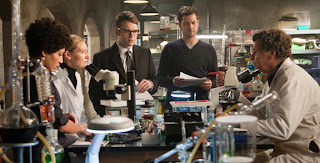 A woman jumps from a tall building with a man committing suicide and is videotaped walking away unscathed. The team begins an investigation and soon discover that she seems unable to die. Meanwhile, William Bell has effectively possessed Olivia, and uses the division's resources to find a more suitable host. Guest stars Paula Malcolmson of Caprica and Deadwood fame, and directed by Charles Beeson, who also directed two other not very good episodes of Fringe.
Right away the episode got off to a shaky start. The lead-in had a very strange overwrought tone to it (the title of this post is derived of a recurring and shallow metaphor that makes its first appearance here), and the whole episode failed to recover from it or redeem itself. Now, the episode had a lot going against it immediately. Because Olivia was taken out of the field, Peter was relied upon to do much of the legwork. The plot also revolved heavily around suicide and featured two, and suicides are easy to handle badly. The only way to enjoy Fringe is to forgive some cheese every now and then, here and there, but "Stowaway" had a pile that just got too big too quickly. There was an abundance of questionable philosophy about life, death, fate, and purpose coming from scientists. At one point William Bell said something to the effect of: "As a scientist, I don't like the idea that anything is without purpose," and while anyone can believe that, it's not a scientific ideology. The science behind this week's monster was pretty lame and loose, the plot was bloated with exposition for an episode where very little actually happened, and characters came to unreasonable conclusions based on sketchy data and were proven correct. The only highlights were an occasionally good Leonard Nimoy impression from Anna Torv, and seeing William and Walter working together (even if only sort of) is fun even when it's stupid. Normally I would think that introducing this universe's Lincoln Lee would win it points, but even that was mishandled, with Lee playing a rookie sidekick to Peter (even though Lee's a goddamn FBI agent and Peter's not anything) and offering no insights on Lee's character nor building a relationship with the rest of the cast. Hands down the worst episode of season three.

Right away the episode got off to a shaky start. The lead-in had a very strange overwrought tone to it (the title of this post is derived of a recurring and shallow metaphor that makes its first appearance here), and the whole episode failed to recover from it or redeem itself. Now, the episode had a lot going against it immediately. Because Olivia was taken out of the field, Peter was relied upon to do much of the legwork. The plot also revolved heavily around suicide and featured two, and suicides are easy to handle badly. The only way to enjoy Fringe is to forgive some cheese every now and then, here and there, but "Stowaway" had a pile that just got too big too quickly. There was an abundance of questionable philosophy about life, death, fate, and purpose coming from scientists. At one point William Bell said something to the effect of: "As a scientist, I don't like the idea that anything is without purpose," and while anyone can believe that, it's not a scientific ideology. The science behind this week's monster was pretty lame and loose, the plot was bloated with exposition for an episode where very little actually happened, and characters came to unreasonable conclusions based on sketchy data and were proven correct. The only highlights were an occasionally good Leonard Nimoy impression from Anna Torv, and seeing William and Walter working together (even if only sort of) is fun even when it's stupid. Normally I would think that introducing this universe's Lincoln Lee would win it points, but even that was mishandled, with Lee playing a rookie sidekick to Peter (even though Lee's a goddamn FBI agent and Peter's not anything) and offering no insights on Lee's character nor building a relationship with the rest of the cast. Hands down the worst episode of season three.
March 15, 2011
Catching Up With Fringe
TV Review: Fringe, "6B"
 Partygoers at a New York apartment fall mysteriously to their deaths, and it soon becomes apparent that they actually fell through the balcony they were standing on. The team rushes to find the source of this dimensional compromise before it becomes too large for them to handle. Guest stars include Colby Johannson, who is super cute and was on a couple episodes of Battlestar: Galactica, and Phyllis Somerville: prolific old lady. Directed by Tom Yatsko, who also directed "White Tulip," one of the best episodes of the series.
Rant alert: the concept of parallel universes independent of each other with slightly different versions of ourselves doesn't really work in any logical way if you think about it too long, but Fringe usually has a way of discouraging thinking for too long. To hearken back to the theme of a Dr. Manhattan speech in The Watchmen, the chances of any one person existing are so slim that their existence is clinically miraculous. This sounds very profound if you don't think about the exponentially larger figure of potential people that never existed. Basically: there are too many variables involved in a person being conceived and subsequently being born for them to coincide by chance in two distinct universes. Now for the purposes of Fringe (and, I suppose, Sliders) I can generally shrug that logic off, however in the episode "6B," the common elements of the two universes were flouted in front of the audience and it was difficult to ignore. The premise was that an elderly couple existed in both universes, but in our universe the man had died and in the other the woman had died due to differing results of a coin flip. They also, incidentally, live in the same apartment in a building which also exists on both sides. The surviving wife and husband are so devastated by their grief for each other that they compromise the dimensional barriers separating the two universes.
This was actually not that bad an episode, mostly because of Walter's continuing struggle with himself trying to repair the damage he's caused, and also we finally got to move forward with Peter and Olivia's relationship. Walter's goal of duplicating Walternate's amber 31422 highlighted his growing desperation at the deterioration of our universe that he is responsible for. Brace yourself for one of Peter's stupid speeches, which inevitably saves the day.
While this episode takes no discernible nods from X-Files, it does take an odd inspiration from "The Farnsworth Parabox," an episode of Futurama which featured a parallel universe whose only difference was that coin flips had opposite results.
TV Review: Fringe, "Subject 13"
 Back in 1984, Walter and his wife Elizabeth try to acclimatize Peter to his new home and dispel his suspicions that they aren't actually his parents. Walter also discovers that one of his young test subjects, Olive, is responding to the Cortexiphan treatments in ways he might be able to use to transport Peter back to his own universe. But Olive's got shit to deal with at home. Guest stars include Chandler Canterbury and Karley Scott Collins as young Peter and Olivia, respectively, as well as prolific TV actress Sarah-Jane Redmont, who I mostly equate with Millennium's terrifying Lucy Butler. Directed by Fred Toye.
I encountered with this episode the same problem I have with Smallville. Olivia's fragmentary memories of Jacksonville make a certain amount of sense, but for her and Peter to have shared a fairly memorable childhood experience (running off) that they both seem to completely forgotten is pretty convenient, and seems like an unnecessary ploy to build a prior history between them when they don't really need it. Luckily, 80s Fringe is always a lot of fun, and we also got to see insights into Peter's relationship with Elizabeth, and some elaboration on what drove her to suicide. John Noble nails is performance as a pre-lobotomized Walter, slightly more brilliant but still pretty sinister. Young Peter is a better actor than Joshua Jackson.
TV Review: Fringe, "Os"
 A botched robbery at a metal depository reveals that someone is developing an injection that allows people to levitate. Unfortunately, the process isn't quite perfected yet. Walter, frustrated at his inability to figure out how this was achieved, resumed his research to commune with William Bell. Guest stars Spin City's Alan Ruck, that actor who was everywhere in the 90s, sexy Greyston Holt, and a cameo from Lost's Jorge Garcia. Directed by Brad Anderson, my favourite Fringe director.
This was the first episode featuring Olivia and Peter the couple, so we got to see that Anna Torv and Joshua Jackson share little to no sexual chemistry. I thought it a bit interesting that, perhaps to confirm Peter's defense as to why he hadn't seen through Fauxlivia, Olivia has begun to act a bit more like her. She's slightly more relaxed, smiles more frequently, and is possessed of a better humour. Walter's outlandish plans to essentially resurrect William Bell are kind of all over the place and follow no real pattern. His conclusion that his breach of the dimensional barrier has relaxed the laws of science suggests that Fringe is only going to get crazier, which I'm all right with. Alan Ruck's well-meaning but misguided scientist is given more attention than many of the previous well-meaning but misguided scientists, but Ruck is good enough to hold our attention. As to the big twist at the end of the episode: I'm cautiously optimistic. Anna Torv has had a demanding role as it is, but I feel like if anyone had to do a Leonard Nimoy impression for shows at a time, it might end up looking a bit silly. We'll have to wait and see.

Rant alert: the concept of parallel universes independent of each other with slightly different versions of ourselves doesn't really work in any logical way if you think about it too long, but Fringe usually has a way of discouraging thinking for too long. To hearken back to the theme of a Dr. Manhattan speech in The Watchmen, the chances of any one person existing are so slim that their existence is clinically miraculous. This sounds very profound if you don't think about the exponentially larger figure of potential people that never existed. Basically: there are too many variables involved in a person being conceived and subsequently being born for them to coincide by chance in two distinct universes. Now for the purposes of Fringe (and, I suppose, Sliders) I can generally shrug that logic off, however in the episode "6B," the common elements of the two universes were flouted in front of the audience and it was difficult to ignore. The premise was that an elderly couple existed in both universes, but in our universe the man had died and in the other the woman had died due to differing results of a coin flip. They also, incidentally, live in the same apartment in a building which also exists on both sides. The surviving wife and husband are so devastated by their grief for each other that they compromise the dimensional barriers separating the two universes.
This was actually not that bad an episode, mostly because of Walter's continuing struggle with himself trying to repair the damage he's caused, and also we finally got to move forward with Peter and Olivia's relationship. Walter's goal of duplicating Walternate's amber 31422 highlighted his growing desperation at the deterioration of our universe that he is responsible for. Brace yourself for one of Peter's stupid speeches, which inevitably saves the day.
While this episode takes no discernible nods from X-Files, it does take an odd inspiration from "The Farnsworth Parabox," an episode of Futurama which featured a parallel universe whose only difference was that coin flips had opposite results.
TV Review: Fringe, "Subject 13"

I encountered with this episode the same problem I have with Smallville. Olivia's fragmentary memories of Jacksonville make a certain amount of sense, but for her and Peter to have shared a fairly memorable childhood experience (running off) that they both seem to completely forgotten is pretty convenient, and seems like an unnecessary ploy to build a prior history between them when they don't really need it. Luckily, 80s Fringe is always a lot of fun, and we also got to see insights into Peter's relationship with Elizabeth, and some elaboration on what drove her to suicide. John Noble nails is performance as a pre-lobotomized Walter, slightly more brilliant but still pretty sinister. Young Peter is a better actor than Joshua Jackson.
TV Review: Fringe, "Os"

This was the first episode featuring Olivia and Peter the couple, so we got to see that Anna Torv and Joshua Jackson share little to no sexual chemistry. I thought it a bit interesting that, perhaps to confirm Peter's defense as to why he hadn't seen through Fauxlivia, Olivia has begun to act a bit more like her. She's slightly more relaxed, smiles more frequently, and is possessed of a better humour. Walter's outlandish plans to essentially resurrect William Bell are kind of all over the place and follow no real pattern. His conclusion that his breach of the dimensional barrier has relaxed the laws of science suggests that Fringe is only going to get crazier, which I'm all right with. Alan Ruck's well-meaning but misguided scientist is given more attention than many of the previous well-meaning but misguided scientists, but Ruck is good enough to hold our attention. As to the big twist at the end of the episode: I'm cautiously optimistic. Anna Torv has had a demanding role as it is, but I feel like if anyone had to do a Leonard Nimoy impression for shows at a time, it might end up looking a bit silly. We'll have to wait and see.
February 18, 2011
News From Over There
TV Review: Fringe, "Immortality"
 I had high hopes going into this week's Fringe, directed as it was by Brad Anderson whose other episodes this season have been "The Plateau" and "Entrada," the two best episodes this season (easily) and arguably among the best of the series - top ten material at the very least. This was also the first episode since "Entrada" to return to the other universe which is always a lot of fun. Not just for the zany balls-out science fiction it necessarily embraces but also because we get to see Charlie Francis back in action, as well as the luscious Lincoln Lee, played by Seth Gabel, a hotter, more talented version of Joshua Jackson.
Though this episode didn't make it to the same level as Anderson's earlier episodes, it's probably the best since the move to Friday nights. As it was completely divorced from our universe (I believe it's the first episode to have no characters from our side) and featured its own indigenous villain, we were able to see the alternate team as protagonists and more human characters. A very good touch early on was demonstrating that Walternate was unwilling to experiment on children - a step our pre-crazy Walter took frequently and which resulted in one ruined life after another. Walternate's always been a ruthless and focused antagonist in some aspects (such as dealing with Broyles), but he very clearly has his head on straight. Similarly, as Fauxlivia is reunited with her sexy boyfriend Frank, we get to see the sincere side of her, whereas during her stay in our world we more equated her with deceit. And when that relationship falls apart after we got to see how happy they were together, it's legitimately moving.
Killer roaches are at the heart of this episode, which of course immediately conjures up scenes from "War of the Coprophages," a very memorable X-Files, but the episode's villain takes the idea and makes it immediately more Fringe-y by being on a quest to cure some disease through a roach enzyme, but because these particular roaches were parasites to sheep and sheep are all extinct in this world (as of the 80s), he had to engineer a species that could subsist on another creature, and the only viable alternative turned out to be man. The extinct sheep thing is another of the other side's conventions, introducing elements present or absent in this world through exposition casual enough to sell it.
The final confrontation is pretty cool, and Lee is a much more convincing action hero than Peter. The "Is Fauxlivia dying?" fake-out actually had me going for a bit, despite maybe being a bit of a stretch (that's some very timely morning sickness) but really that's a hard complaint to lodge when I'm watching Fringe. Which is of course the big reveal here: Fauxlivia is pregnant, and with Peter's kid; and she still loves him. While the looming love triangle - or more specifically, its significance to the fate of the universe - has me bracing myself, it's nice that they're willing to throw in some obstacles to at least make it seem like it's not quite so clear cut that Peter will choose Olivia.

Though this episode didn't make it to the same level as Anderson's earlier episodes, it's probably the best since the move to Friday nights. As it was completely divorced from our universe (I believe it's the first episode to have no characters from our side) and featured its own indigenous villain, we were able to see the alternate team as protagonists and more human characters. A very good touch early on was demonstrating that Walternate was unwilling to experiment on children - a step our pre-crazy Walter took frequently and which resulted in one ruined life after another. Walternate's always been a ruthless and focused antagonist in some aspects (such as dealing with Broyles), but he very clearly has his head on straight. Similarly, as Fauxlivia is reunited with her sexy boyfriend Frank, we get to see the sincere side of her, whereas during her stay in our world we more equated her with deceit. And when that relationship falls apart after we got to see how happy they were together, it's legitimately moving.
Killer roaches are at the heart of this episode, which of course immediately conjures up scenes from "War of the Coprophages," a very memorable X-Files, but the episode's villain takes the idea and makes it immediately more Fringe-y by being on a quest to cure some disease through a roach enzyme, but because these particular roaches were parasites to sheep and sheep are all extinct in this world (as of the 80s), he had to engineer a species that could subsist on another creature, and the only viable alternative turned out to be man. The extinct sheep thing is another of the other side's conventions, introducing elements present or absent in this world through exposition casual enough to sell it.
The final confrontation is pretty cool, and Lee is a much more convincing action hero than Peter. The "Is Fauxlivia dying?" fake-out actually had me going for a bit, despite maybe being a bit of a stretch (that's some very timely morning sickness) but really that's a hard complaint to lodge when I'm watching Fringe. Which is of course the big reveal here: Fauxlivia is pregnant, and with Peter's kid; and she still loves him. While the looming love triangle - or more specifically, its significance to the fate of the universe - has me bracing myself, it's nice that they're willing to throw in some obstacles to at least make it seem like it's not quite so clear cut that Peter will choose Olivia.
February 7, 2011
What Other People Are Thinking
TV Review: Fringe, "Concentrate and Ask Again"
 This week's Fringe seemed more committed to being a monster-of-the-week episode. Despite a recap detailing the First People and the doomsday device, the plot was more like a season one episode, with nondescript one-off villains attacking people who kind of deserve it with bizarre and usually disgusting methods. Throw in a Cortexiphan kid for good measure.
The episode starts off with a strange exchange between Nina and Olivia. I guess now that Walter owns Massive Dynamic Nina's not quite as dubious a character, but Olivia's not very forthcoming on the best of times and given their past and Nina's constant cloak and dagger routines I thought it odd that Olivia would be so familiar with her, going so far as to comment on the state of her relationship with Peter. Although I suppose this was as good a setup as any for that conversation with Peter that seems to be a feature of every episode. This time, Olivia confronted Peter to see if he still has feelings for her alternate, and Peter gives her a speech about how much he loves this Olivia. But he's given her the same speech so many times I feel like he should be at the point of telling her off when she rubs his nose in it week after week, despite fairly transparent passive aggression. If this episode is any indication, unfortunately, their relationship (and Peter's accidental infidelity) is only going to become more central to the show as the series progresses.
Nina takes her usual place in the dugout fairly early on, but has more screen time this episode than she has in a while, but still hasn't really elaborated her character at all. She describes her relationship with William Bell as "complicated," and muses to herself on his many secrets. Does anyone else remember that she and Broyles made out like two years ago? Was that just one crazy weekend or something? Either way, it adds some sexy tension to a scene shared between them and CIA correspondent Agent Edwards played by the delicious JR Bourne. "What Nina Sharpe wants, she gets." Do I see a three-way in the future? Cross your fingers.
Despite being largely about Peter, he's not actually that involved in the plot - no acknowledgement is given to the "Peter might be going crazy" element introduced last week. The bad guys here are trying to use a chemical weapon that dissolves bones and when the only lead is in a coma, Walter tries bringing in telepathic Cortexiphan kid, new character Simon Philips, to stop the weapon from being used again.
Telepathy is definitely no stranger to X-Files, particularly with recurring character Gibson Praise, and Simon's need to exile himself from society because hearing people think drives him crazy is reminiscent of an episode ("Tin Man") of Star Trek: The Next Generation. Fringe doesn't really add anything in that capacity, but Simon was a welcome addition to the roster, if perhaps a tad convenient for him to be necessary right when Olivia's trying to sort out what Peter is thinking. I'll be curious to see what (if anything) the show decides to do with Simon, as Olivia's immunity to his powers could propel her to involve herself in his life. Fringe seems to know better than to have characters using superpowers on a regular basis, and while I don't advocate having Simon the mind-reader helping out on every case, it would be nice to give Olivia an alternative love interest to Peter, if for no other reason than to add another factor to the newest reveal from Sam Weiss. Simon is also another reminder to Walter that he spent many years indiscriminately ruining lives. They share an exchanged glance that may have been one of the best moments of the episode. Another being Anna Torv in an evening dress.
Now that Fauxlivia is out of the picture and we're not alternating weekly between Universe A and Universe 1, Fringe has had to focus in on some plot points that seem insignificant in comparison to what's come before. Fauxlivia's involvement added some great tension to every scene she was in, and we also benefited from having Charlie and Lee who are both much cooler characters than Peter. Obviously it couldn't last forever, but now it feels like we're treading water waiting for it to get awesome again. I'm not worried that it won't get back into the groove, or whatever - 24 episode seasons are long seasons, these days - and it seems to have consistent ratings so it probably won't just up and get cancelled. But we may be in the middle of a slight dry spell.

The episode starts off with a strange exchange between Nina and Olivia. I guess now that Walter owns Massive Dynamic Nina's not quite as dubious a character, but Olivia's not very forthcoming on the best of times and given their past and Nina's constant cloak and dagger routines I thought it odd that Olivia would be so familiar with her, going so far as to comment on the state of her relationship with Peter. Although I suppose this was as good a setup as any for that conversation with Peter that seems to be a feature of every episode. This time, Olivia confronted Peter to see if he still has feelings for her alternate, and Peter gives her a speech about how much he loves this Olivia. But he's given her the same speech so many times I feel like he should be at the point of telling her off when she rubs his nose in it week after week, despite fairly transparent passive aggression. If this episode is any indication, unfortunately, their relationship (and Peter's accidental infidelity) is only going to become more central to the show as the series progresses.
Nina takes her usual place in the dugout fairly early on, but has more screen time this episode than she has in a while, but still hasn't really elaborated her character at all. She describes her relationship with William Bell as "complicated," and muses to herself on his many secrets. Does anyone else remember that she and Broyles made out like two years ago? Was that just one crazy weekend or something? Either way, it adds some sexy tension to a scene shared between them and CIA correspondent Agent Edwards played by the delicious JR Bourne. "What Nina Sharpe wants, she gets." Do I see a three-way in the future? Cross your fingers.
Despite being largely about Peter, he's not actually that involved in the plot - no acknowledgement is given to the "Peter might be going crazy" element introduced last week. The bad guys here are trying to use a chemical weapon that dissolves bones and when the only lead is in a coma, Walter tries bringing in telepathic Cortexiphan kid, new character Simon Philips, to stop the weapon from being used again.
Telepathy is definitely no stranger to X-Files, particularly with recurring character Gibson Praise, and Simon's need to exile himself from society because hearing people think drives him crazy is reminiscent of an episode ("Tin Man") of Star Trek: The Next Generation. Fringe doesn't really add anything in that capacity, but Simon was a welcome addition to the roster, if perhaps a tad convenient for him to be necessary right when Olivia's trying to sort out what Peter is thinking. I'll be curious to see what (if anything) the show decides to do with Simon, as Olivia's immunity to his powers could propel her to involve herself in his life. Fringe seems to know better than to have characters using superpowers on a regular basis, and while I don't advocate having Simon the mind-reader helping out on every case, it would be nice to give Olivia an alternative love interest to Peter, if for no other reason than to add another factor to the newest reveal from Sam Weiss. Simon is also another reminder to Walter that he spent many years indiscriminately ruining lives. They share an exchanged glance that may have been one of the best moments of the episode. Another being Anna Torv in an evening dress.
Now that Fauxlivia is out of the picture and we're not alternating weekly between Universe A and Universe 1, Fringe has had to focus in on some plot points that seem insignificant in comparison to what's come before. Fauxlivia's involvement added some great tension to every scene she was in, and we also benefited from having Charlie and Lee who are both much cooler characters than Peter. Obviously it couldn't last forever, but now it feels like we're treading water waiting for it to get awesome again. I'm not worried that it won't get back into the groove, or whatever - 24 episode seasons are long seasons, these days - and it seems to have consistent ratings so it probably won't just up and get cancelled. But we may be in the middle of a slight dry spell.
January 31, 2011
Get Touched Back
TV Review: Fringe, "Reciprocity"
 Spoilers ahead. Following Fringe's strong return last week is an episode with a number of problems, or at least enough silly moments to have me rolling my eyes. It is still a good episode but it's probably among the weakest of the season. Massive Dynamic has reconstructed the universe-shattering doomsday device, but can't figure out what it does or how to power it, and it is unresponsive to all input until Peter enters the room and gets a nosebleed. Until now, the doomsday device has kind of been a side project of importance to the series but never thrown around in our faces. Seeing it full constructed in a hangar-sized laboratory raised some concerns, chiefly: why the hell did they build it? The interdimensional arms race only makes so much sense, and the most widely accepted theory seems to be that the doomsday device with either destroy our universe or both. Broyles, Nina, and Peter all insist that they need to understand what it does so that they can combat it, and only Walter is the voice of dissent, pointing out that they are building a doomsday device, and his concerns are dismissed as Walter's usual crazy diatribes. Plus, since it's Massive Dynamic that's running the show and Walter owns it, I don't see why he can't just shut down the operation completely. I can ignore these questions and enjoy the show, but it would be nice if we had more logical reasoning from our major characters.
So anyway, meanwhile Fauxlivia's computer has been decrypted and right afterwards, people identified as shapeshifters start popping up executed with their hard-drives removed. The shapeshifters are still a cool device and the series seems to know well enough to keep them scattered so that we're not getting bored of them. Making them the victims here as opposed to the predators they usually are does dull their teeth a bit, though, and I found myself really missing a cool headlining villain like Newton. Having to review Fauxlivia's data brings once again brings up the newfound tension between Peter and Olivia, but in the end it works to solve as opposed to exacerbate the problem, which is becoming something of a pattern that I hope they don't stretch too thin. Even here I was getting a little tired of the same conversation happening between them.
Also meanwhile, Walter is continuing his attempts to regrow the parts of his brain that were lost so that he can stand toe to toe with Walternate, smartswise. This was a somewhat silly subplot last week and it only gets worse this episode, as after getting assistance from Nina, Walter takes an unlabelled formula which turns out to be ape DNA, and then he starts acting like a monkey. Luckily, this never goes beyond having cravings for bananas and making animal grunts, but it was still a facepalm moment. I hope that they wrap this thing up soon, because it sort of undercuts the implication we faced last season that pre-lobotomized Walter was not a good guy, and it will cement it if he manages to recover his losses and is still doddering apologetic Walter.
One of the major drawbacks of this episode was that it was very focused on Peter and had to thusly lean heavily on Joshua Jackson and his acting abilities. Peter's a weak link on the show for a number of reasons, chiefly Joshua Jackson, but also because he's been written as some kind of genius jack-of-all-trades, which comes back into play here when it's revealed that it's Peter tracking down and killing the shapeshifters. Not only is he a master cryptologist, as he solves Fauxlivia's cipher before Astrid, a team of FBI code-breakers, and even Olivia herself manage to, but he's also an exacting assassin able to overcome shapeshifting cyborg agents even when they get the drop on him. Making Peter more sinister may be a smart move, as I find bad actors have an easier time acting evil (see Sarah Michelle Gellar as the First), but it also threatens to pull Peter back into the centre of the show when he'd been sidelined most of the season by much more interesting characters and plotlines. I guess we'll have to wait and see. This Walter and Peter keep a secret from Olivia thing is dangerously similar to Walter and Olivia keeping a secret from Peter last season.
I'm bashing the episode a lot but it was still better than most shit on TV, and the final fight between Peter and the shapeshifter was more exciting than not. I hope the writers inject a new bad guy into the show soon, though, because as threatening as Fauxlivia, Walternate, and the other Fringe division are, they're pretty much non-entities, and even so are no match for the exacting villainy of earlier foes like David Robert Jones and Newton.

So anyway, meanwhile Fauxlivia's computer has been decrypted and right afterwards, people identified as shapeshifters start popping up executed with their hard-drives removed. The shapeshifters are still a cool device and the series seems to know well enough to keep them scattered so that we're not getting bored of them. Making them the victims here as opposed to the predators they usually are does dull their teeth a bit, though, and I found myself really missing a cool headlining villain like Newton. Having to review Fauxlivia's data brings once again brings up the newfound tension between Peter and Olivia, but in the end it works to solve as opposed to exacerbate the problem, which is becoming something of a pattern that I hope they don't stretch too thin. Even here I was getting a little tired of the same conversation happening between them.
Also meanwhile, Walter is continuing his attempts to regrow the parts of his brain that were lost so that he can stand toe to toe with Walternate, smartswise. This was a somewhat silly subplot last week and it only gets worse this episode, as after getting assistance from Nina, Walter takes an unlabelled formula which turns out to be ape DNA, and then he starts acting like a monkey. Luckily, this never goes beyond having cravings for bananas and making animal grunts, but it was still a facepalm moment. I hope that they wrap this thing up soon, because it sort of undercuts the implication we faced last season that pre-lobotomized Walter was not a good guy, and it will cement it if he manages to recover his losses and is still doddering apologetic Walter.
One of the major drawbacks of this episode was that it was very focused on Peter and had to thusly lean heavily on Joshua Jackson and his acting abilities. Peter's a weak link on the show for a number of reasons, chiefly Joshua Jackson, but also because he's been written as some kind of genius jack-of-all-trades, which comes back into play here when it's revealed that it's Peter tracking down and killing the shapeshifters. Not only is he a master cryptologist, as he solves Fauxlivia's cipher before Astrid, a team of FBI code-breakers, and even Olivia herself manage to, but he's also an exacting assassin able to overcome shapeshifting cyborg agents even when they get the drop on him. Making Peter more sinister may be a smart move, as I find bad actors have an easier time acting evil (see Sarah Michelle Gellar as the First), but it also threatens to pull Peter back into the centre of the show when he'd been sidelined most of the season by much more interesting characters and plotlines. I guess we'll have to wait and see. This Walter and Peter keep a secret from Olivia thing is dangerously similar to Walter and Olivia keeping a secret from Peter last season.
I'm bashing the episode a lot but it was still better than most shit on TV, and the final fight between Peter and the shapeshifter was more exciting than not. I hope the writers inject a new bad guy into the show soon, though, because as threatening as Fauxlivia, Walternate, and the other Fringe division are, they're pretty much non-entities, and even so are no match for the exacting villainy of earlier foes like David Robert Jones and Newton.
January 24, 2011
The Death Slot

Season three has been the best so far. Every episode has been pretty strong, and they seem to have adopted a good formula of keeping shows episodic monster-of-the-week storylines while still addressing the overarching concerns of the series. When Fringe was moved to the Friday night slot traditionally reserved for shows Fox was trying to sabotage so they could cancel them, everyone assumed the worst, and that the first episode in that slot was called "The Firefly" reminded everyone of Fox's dubious treatment of good shows. Nevertheless, Fringe had the highest ratings of any show last Friday. We'll have to wait and see if this momentum keeps up, but Fringe is a great show that deserves an audience now more than ever.
TV Review: Fringe, "The Firefly"

Though the Observer was occasionally positioned as the antagonist, it was really an episode with no villain, which can be difficult to pull off. Luckily, the episode sort of lay blame on Walter himself, and brought back to the surface Walter's conflict between a sincere love for his son, and guilt about all the negative ramifications he caused to save him. So it was an emotional, Walter-heavy episode, but as John Noble is probably the best actor in the cast that's not a bad thing. We also revisited the complicated relationship between Olivia and Peter, and Peter seemed to make some first steps towards a reconciliation despite Olivia's hesitations. Though this exchange depended on Joshua Jackson's stunted emotive capabilities, it wasn't very demanding so he still handled himself all right.
Like several other episodes this seasons, "The Firefly" was preoccupied with causality, and though it was handled better (or at least cooler) earlier in "The Plateau," it still kept things complicated enough for us to appreciate that the characters couldn't predict what will happen next, but simple enough for us to trace back the cause as we see the effects. It was lighter on action than usual, but the climax was still engaging.
Finally, in a slight bit of trivia, Walter at one point employed a pair of glasses with a red and blue lens, and then claimed that they were an invention of his friend Dr. Jacoby from Washington state, effectively suggesting that Fringe is set in the same universe as Twin Peaks. Maybe the series will end with Olivia rescuing Cooper from the Black Lodge.
January 4, 2011
Reaching for Nothing
TV Review: Seinfeld, "The Finale"
 My roommate got season 9 of Seinfeld over the holidays and last night we watched the finale. I don't remember where I sat with it when the finale aired, and this was the first time I watched it since. I knew it sucked, but watching it again, I hadn't realized just how bad it sucked. And season 9 is actually a pretty good season. Right before watching "The Finale," we watched "The Frogger," which was a hilarious and classic episode. I guess the finale is classic as well at least in that everyone is familiar with it.
Right from the starting stand-up routine (the first in years) you can tell there's a bad approach. This wasn't written as a Seinfeld episode but rather as a Seinfeld Television Event. The first half of the hour long episode plays out like a regular episode but even then, the jokes seem to be trying too hard to be Seinfeldian. Jerry and George give Elaine a hard time for a breach of phone call etiquette (this amounts to the Elaine subplot). Kramer just can't lose his swimmer's ear - how zany! The central Jerry-George plot (the only plot) is that they've finally got the go-ahead on the show they conceived with NBC, and George (as is wont of George) overcompensates by acting like a huge asshole. There's a couple of snickers here and there but everything feels way more contrived than usual and without the wit to justify it. And then it all just gets worse.
The second part is of course the infamous trial. The foursome are grounded in a small town in Massachusetts after a dramatic near crash on an airplane (that's right), where they are arrested for not helping a fat guy as he's getting carjacked. What follows is essentially a clip show - the lowest form of episode - featuring references to virtually all the most memorable and beloved jokes from the last nine years, as guest star after guest star is paraded in front of the audience, reminding you of all the good times you had with them. In a fairly atrocious montage we see all our favourite side characters pack their bags so they can sit in on the trial and be seen in all the long shots. I remember when it aired that City TV marathoned the top ten episodes of Seinfeld in honour of the finale (as voted by you!) and virtually every single episode they featured was touched on. In another montage of character witnesses, we are treated to maybe five or six old incidental guest stars and the occasional clip to go along with it, in the span of maybe two minutes.
I'd like to have known Larry David during this period. He would've been off the show for two years and then asked to come back and write a finale at the apex of Seinfeld-mania. At that point he would've been newly and bombastically rich, but removed from a show that was responsible for his fortune and continues to be lauded as a game-changer, one of the most celebrated sitcoms of all time, and I'm informed, the most successful show in American television history. Coming at this after watching seven years of Curb Your Enthusiasm, I can't help but wonder at David's personal relationship with the show as a force in his life. Did he like it? Did he resent the show's continued success in his absence? Had he gotten to a point where he thought he had pulled a fast one on everyone; that Seinfeld wasn't all it was cracked up to be and we were all idiots for liking it? Maybe he thought the show, and all of us who watched it, deserved to be mocked. Maybe the finale was his way of saying that it's just another crappy sitcom.
Because it does feel in many ways like a big fuck you - an indictment of the whole endeavour. The trial of the characters comes across as a trial of the series, and it ends with a guilty verdict. These are horrible people, and in their nine years of misadventures they've ruined and even ended lives. Why are these beloved characters? Why are you so invested in following the lives of four New York sociopaths? It was a poor choice to treat the finale like anything but another regular Seinfeld episode, but if it has to be a sweeping retrospective, shouldn't it at least be celebratory as opposed to damning?
Ultimately, the episode was moralizing, followed one straight-forward narrative, and largely didn't even take place in New York. In other words it was everything a Seinfeld episode has never been before. The only plus side is that they got to set up for jokes about it ten years later in Curb.

Right from the starting stand-up routine (the first in years) you can tell there's a bad approach. This wasn't written as a Seinfeld episode but rather as a Seinfeld Television Event. The first half of the hour long episode plays out like a regular episode but even then, the jokes seem to be trying too hard to be Seinfeldian. Jerry and George give Elaine a hard time for a breach of phone call etiquette (this amounts to the Elaine subplot). Kramer just can't lose his swimmer's ear - how zany! The central Jerry-George plot (the only plot) is that they've finally got the go-ahead on the show they conceived with NBC, and George (as is wont of George) overcompensates by acting like a huge asshole. There's a couple of snickers here and there but everything feels way more contrived than usual and without the wit to justify it. And then it all just gets worse.
The second part is of course the infamous trial. The foursome are grounded in a small town in Massachusetts after a dramatic near crash on an airplane (that's right), where they are arrested for not helping a fat guy as he's getting carjacked. What follows is essentially a clip show - the lowest form of episode - featuring references to virtually all the most memorable and beloved jokes from the last nine years, as guest star after guest star is paraded in front of the audience, reminding you of all the good times you had with them. In a fairly atrocious montage we see all our favourite side characters pack their bags so they can sit in on the trial and be seen in all the long shots. I remember when it aired that City TV marathoned the top ten episodes of Seinfeld in honour of the finale (as voted by you!) and virtually every single episode they featured was touched on. In another montage of character witnesses, we are treated to maybe five or six old incidental guest stars and the occasional clip to go along with it, in the span of maybe two minutes.
I'd like to have known Larry David during this period. He would've been off the show for two years and then asked to come back and write a finale at the apex of Seinfeld-mania. At that point he would've been newly and bombastically rich, but removed from a show that was responsible for his fortune and continues to be lauded as a game-changer, one of the most celebrated sitcoms of all time, and I'm informed, the most successful show in American television history. Coming at this after watching seven years of Curb Your Enthusiasm, I can't help but wonder at David's personal relationship with the show as a force in his life. Did he like it? Did he resent the show's continued success in his absence? Had he gotten to a point where he thought he had pulled a fast one on everyone; that Seinfeld wasn't all it was cracked up to be and we were all idiots for liking it? Maybe he thought the show, and all of us who watched it, deserved to be mocked. Maybe the finale was his way of saying that it's just another crappy sitcom.
Because it does feel in many ways like a big fuck you - an indictment of the whole endeavour. The trial of the characters comes across as a trial of the series, and it ends with a guilty verdict. These are horrible people, and in their nine years of misadventures they've ruined and even ended lives. Why are these beloved characters? Why are you so invested in following the lives of four New York sociopaths? It was a poor choice to treat the finale like anything but another regular Seinfeld episode, but if it has to be a sweeping retrospective, shouldn't it at least be celebratory as opposed to damning?
Ultimately, the episode was moralizing, followed one straight-forward narrative, and largely didn't even take place in New York. In other words it was everything a Seinfeld episode has never been before. The only plus side is that they got to set up for jokes about it ten years later in Curb.
Subscribe to:
Posts (Atom)